Antoine's Blog
How Large Language Models Work
Introduction
The sudden ubiquity of AI tools like ChatGPT and Claude has left many wondering: What is actually happening under the hood? While it feels like you're talking to a conscious entity, a Large Language Model (LLM) is actually a master of statistical patterns on a massive scale.
In this post, we'll demystify the process of how a machine turns raw text into seemingly intelligent responses.
The Core Concept
At its heart, an LLM doesn't "know" facts in the way humans do. Instead, it performs a series of complex mathematical transformations to predict what comes next.
1. Tokenization
Computers cannot read words; they read numbers. The first step is Tokenization, where text is broken down into smaller chunks called tokens. These can be whole words, syllables, or even individual characters. Example: "Elephant" might be one token, while "unbelievable" might be split into "un", "believ", and "able".
2. Embeddings (The Map of Meaning)
Once tokenized, each token is converted into an Embedding. This is a long list of numbers (a vector) that represents the token's meaning in a high-dimensional space. Tokens with similar meanings (like "apple" and "pear") are placed closer together in this mathematical space, allowing the model to understand relationships between concepts.
3. The Transformer and Attention
The "secret sauce" of modern LLMs is the Transformer architecture, specifically the Attention mechanism. This allows the model to look at every token in a sentence and decide which other tokens are most important for understanding the context. In the sentence "The bank of the river was muddy," the attention mechanism helps the model realize that "bank" refers to land, not a financial institution, by looking at the word "river".
4. Next-Token Prediction
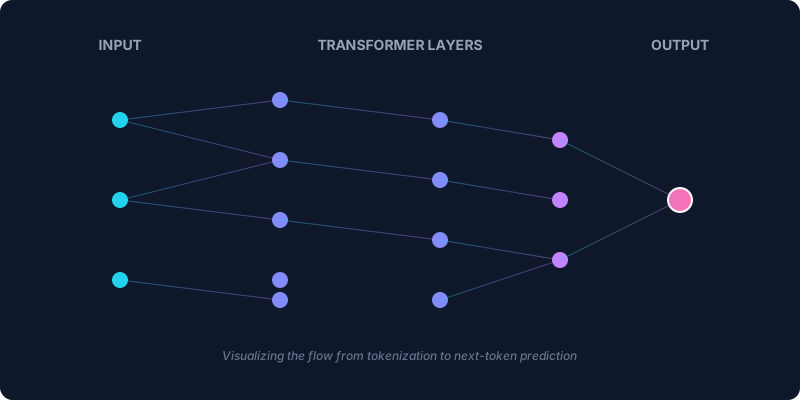
After processing the input through these layers, the model doesn't "write" a sentence; it predicts the single most likely next token. It then appends that token to the sequence and repeats the process, over and over, until the response is complete.
Key Takeaways
- Patterns, Not Consciousness: LLMs are probabilistic engines. They don't "think"; they calculate the most likely sequence of characters based on their training data.
- Training Scale: Their "intelligence" comes from the sheer volume of data (petabytes of text) and parameters (billions of connections) used during training.
- Hallucinations: Because they are predicting probabilities rather than querying a database, they can confidently generate "facts" that don't exist—this is known as hallucination.
Conclusion
Understanding that LLMs are sophisticated "autocomplete" systems doesn't diminish their utility—it actually helps us use them more effectively. By recognizing that they rely on patterns and context, we can better prompt them and remain critical of the information they provide.
The bridge between statistical probability and human-like conversation is one of the most fascinating engineering achievements of the decade.